Benefits of working with a TPI Certified Professional
Golf requires a unique combination of flexibility, stability and strength that allows you to swing a golf club effectively and efficiently. Additionally, driving distance (using PGA tour statistics) is directly and linearly related to vertical jump height, i.e., if you are strong enough to drive your body vertically you are also strong enough to hit a golf ball down the fairway. But, if you have limited motion through your hips, upper back or shoulders, you may struggle to rotate in your backswing or clear your hips on the downswing. These factors can lead to lost distance or a fade/draw. If you have trouble touching your toes or squatting down, you may not be able to stay down on the golf ball, which leads to hitting shots thin. Your physical ability directly affects your ability to apply force with a club to a golf ball.
In 2003, Titleist decided to invest heavily in researching how the human body interacts with the golf swing by creating the Titleist Performance Institute (TPI). TPI’s mission is to educate golfers and golf industry professionals on the Body-Swing Connection, or showing how a player’s physical limitations can adversely affect their play or lead to injury.
Essentially, TPI’s purpose is to determine what “golf fitness” is and how it relates to the golf swing. Currently, TPI-certified medical, fitness and golf professionals have supported 19 of the last 20 major tournament winners, 25 of the top 30 players in the world and the winners of 52 of the last 63 PGA tour events. While the PGA tour stats are great, Titleist also wants to help the amateur golfer enjoy the game more and be able to play more golf.
Almost 70 percent of golfers report that they play with low back pain. Juniors and ladies are picking up the game less frequently. The number of rounds of golf being played annually in the U.S. has continued to decline and more players have left the game due to injury or frustration. TPI is Titleist’s attempt to fix these problems.
Lack of flexibility is the number one cause leading to poor shots! Lacking flexibility will cause something called early extension, which is defined by any forward movement towards the golf ball during the downswing. This swing characteristic causes the arms and club to get stuck behind your body during the downswing, forcing your torso to raise up and elevate through the hitting zone. This will cause a push right or a hook left.
63.4% of amateurs have this problem. Research has shown the lack of the ability to perform a proper squat or ability to touch your toes can cause a player to early extend. Improving your hip and torso motion, hamstring flexibility and core strength will help dramatically rectify this minor problem.
Working with a TPI Certified Professional will allow you to quickly identify the problem areas, create a plan to address these deficiencies and begin to improve your strength which will naturally translate to the golf course.
Here are three simple exercises that you can start with:
Toe Touch: https://youtu.be/3vn4F2Bzj1Q
Thread The Needle: https://youtu.be/qv_IFWKXDAw
½ Kneeling Paloff Press: https://youtu.be/H1nCNtZDekk
Improving your hip motion will allow your pelvis to rotate around the lead hip, negating the forward and lateral motions. By improving your hamstring flexibility via toe touching, you will improve your ability to stay down on the ball and not “early extend” Lastly, improving your torso mobility will allow your upper body and lower body to move independently, letting your torso and arms rotate as you swing, giving you a more accurate and powerful swing!
All three exercises done on a regular basis, not just on days you play, will allow for a symmetry in your swing you’ve never experienced. For more exercises or to download the full 10-week golf workout, please visit our video library.
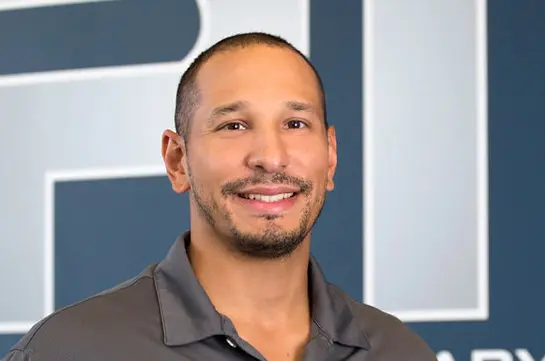
Meet the Author:
Dr. Brandon Cruz, PT, DPT, OCS, SCS, CSCS, FAAOMPT
Founder, Pursue PT
Dr. Brandon Cruz is a Partner at Mosaic Golf and the Founder of Pursue Physical Therapy. He received his Bachelor of Science degree in Kinesiology from Temple University and continued his postgraduate work at UMDNJ, now Rutgers University, where he went on to graduate with his Doctorate of Physical Therapy degree. Dr. Cruz is fellowship trained and has obtained an elite distinction holding duel Board Certifications in Orthopedic and Sports Rehabilitation (OCS), (SCS) putting him in the top 1% of all practitioners in the country.
During his time at Temple, Dr. Cruz was fortunate enough to work side-by-side with the university’s top physical therapist and strength coaches to help facilitate rehab programs for their Division 1 athletes. Dr. Cruz also spent time at The University of Florida’s Orthopedic and Sports Medicine Institute where he had the opportunity to work with rising D-1 Athletes across a number of sports. He is also an active member and advocate for the APTA sports, orthopedic sections, and (AAOMPT).
Dr. Cruz is also Titleist Performance Institute (TPI) Certified. He leverages this expertise to help golfers construct their body for their perfect swing. As an avid golfer, he is continually striving to enhance the game.
© Copyright 2023. All Rights Reserved.